2011年9月27日火曜日

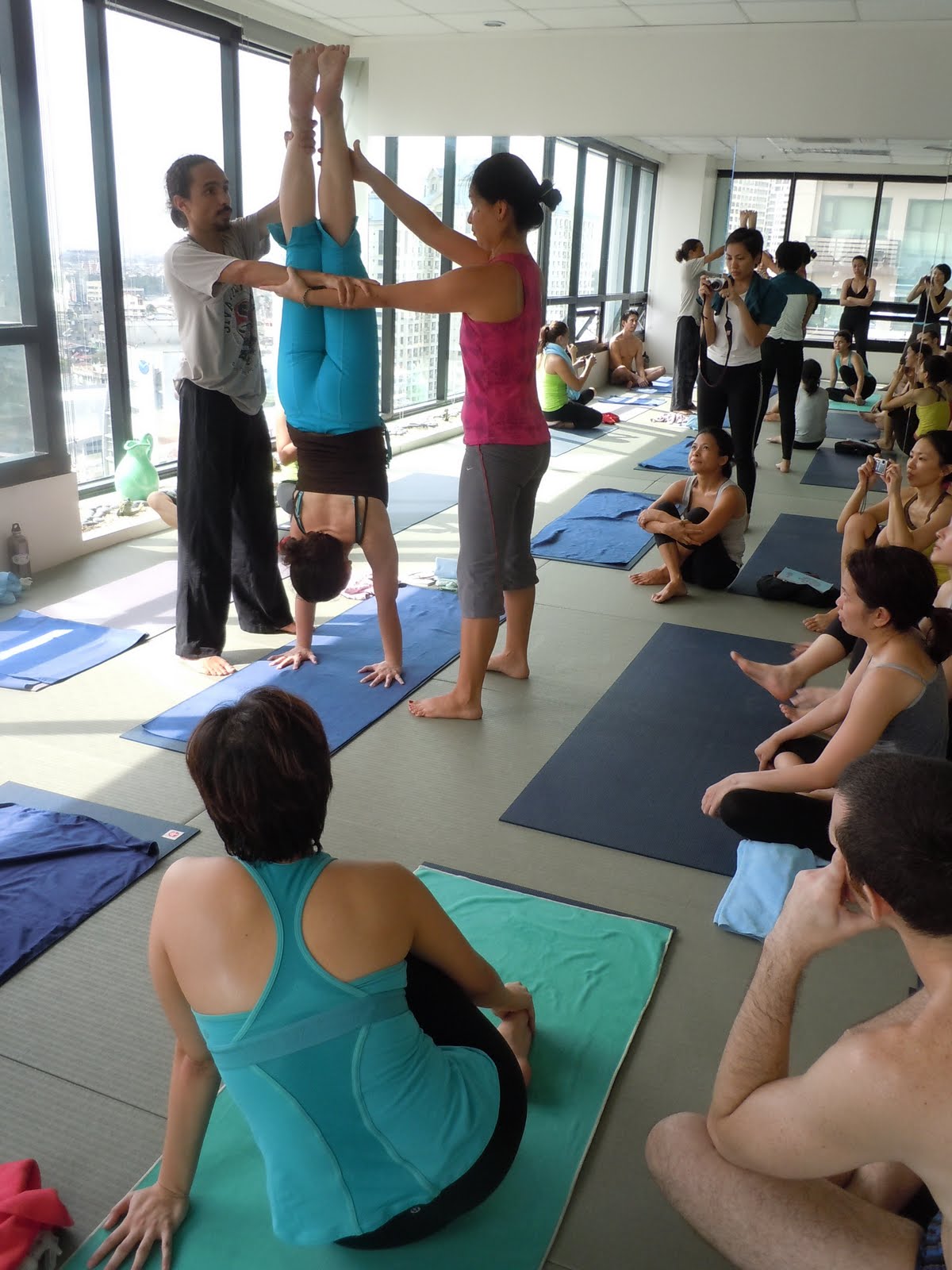
Yoga Workshop of Jules Febre


I attended workshop of Jules Febre.

For my memo and to share with yogis, I'll write down what I learned.

I took back bending class and inversion workshop.
He told us that in our ordinary life, we don't usually back bend or invert ourself.
We do a lot of forward bending when you read a book or use computers, and you always stand on your knees. We don't back bend our body to see what's behind you, and we don't stand on our hands.
Your body took them for granted that we do a lot of forward bending and standing on our foot.
So, it's really good for your body to do back bending and inversion because it surprises your body and at the same time stimulate your body and brain. It's a medicine for rejuvenation!

In back bending, he told us that many people who have problems with back bending, usually not really bending their back. They are bending their neck, arms and legs.

In back bending, we use bones from C7 down to 12 thoracic vertebrae.
For those who are not familiar with anatomy, I'll show you C7 and 12 thoracic vertebrae in picture below.
When you bend your neck forward, there's a bone sticking out. That's C7.

(Picture borrowed from http://www.us.oct-net.jp/~e-fimie/takuma16.html)

So, before starting back bending, we did warm-up with Jivamukti-version suriya namaskara and gradually deepen our asanas to full-bending.

Suriya namaskara→Bhujangasana(cobra pose)→Shalabhasana(locust pose)→Dhanurasana(bow pose)→Urdhva Dhanurasana(bridge pose)

Things that you always have to care about are that you try to bend your C7 down to 12 thoracic vertebrae and relax your neck.

I'll write down more in my next entry!

'

2011年9月18日日曜日

Banana ketchup


Banana ketchup is one of the Filipino condiments.
I didn't know about this ketchup before I came here, but it's everywhere here in Philippines.

In Filipino houses, they have one most of the time. At Filipino or fast food restaurant, they have one.
One of the biggest Filipino fast food, Joli Bee uses this banana ketchup to all menues.

It's created during the World War II. There was a lack of tomatoes, so they looked for substitute. However, without coloring, it's brown and doesn't look good. So they put red color so that it looks like a real ketchup.

I tried tasting it and I like it! It's sweet and of course it has banana taste just a little bit.

'

2011年8月26日金曜日

速攻オクラ料理(Easy and fast okra cooking)


Easy cooking!
This is a popular and easy dish in Japan.

Ingredients for 1 person:

5 pieces of Okras
3g of かつおぶし(Katsuobushi : finely sliced dried bonito)
1 big spoon of soy sauce
1 big spoon of ground sesame

1. Put little bit of salt in a water and boil okra.

2. Mince okra, put it in a bowl along with katsuobushi, soy sauce and ground sesame, and mix them.
3. Eat with rice!

'

2011年8月16日火曜日

柴葉漬け(Shibazuke)


(Picture borrowed from http://www.akaoya.jp/)

Shibazuke is a traditional 漬物(Tsukemono) in Kyoto. It's made by pickling eggplant and red perilla with salt. It's one of the famous Tsukemono in Kyoto along with すぐき(Suguki) and 千枚漬け(Senmaizuke).

Although, it's a traditional Tsukemono in Kyoto, it's so popular in Japan, so you can find it easily in a supermarket in almost all over Japan.

It takes about 1 year until it's properly aged. However, nowadays people don't usually make Shibazuke in an original way. People put cucumber or myoga aside from eggplant, and pickle with vinegar. Originally, it was lactic acid fermentation from lactic acid bacteria, but now the popular way is to use vinegar.
Of course, you can still find Shibazuke made by traditional way, but it's hard to get one and much more expensive.


'

2011年8月9日火曜日

一味唐辛子(Ichimi tougarashi)&七味唐辛子(Shichimi tougarashi)

Ichimi that my friend gave me.


There are 2 types of popular red pepper in Japan.

一味唐辛子(Ichimi tougarashi)
七味唐辛子(Shichimi tougarashi)

一味(Ichimi) means 1 taste and 七味(Shichimi) means 7 tastes in Japanese.
As you can clearly see, ichimi is made from single kind red pepper. Based on ichimi, add 6 other spices or sometimes more, shichimi is made.

The spices that usually put in Shichimi are these:
芥子(Keshi : garden poppy)
陳皮(Chinpi : chenpi)
胡麻(Goma : sesame)
山椒(Sansyou : Japanese pepper)
麻の実(Asa no mi : hempseed)
紫蘇(Shiso : perilla)
海苔(Noli : dried seaweed)
青海苔(Aonoli : dried seaweed)
生姜(Syouga : ginger)
菜種(Natane : rapeseed)

Shichimi was first sold in 1625 by a person whose name was 徳右衛門(Tokuuemon) at 薬研堀(Yagenbori). Some people wanted to use herbal medicine for edible use and Shichimi was created.

We usually put Ichimi and Shichimi in Udon or Soba.

For your reference, you can see all the major Shichimi in Japan, and their feature of original-blended tastes in this website.
(Japanese only)
http://www.albsasa.com/sub1/sub103t_1.html


'

2011年7月31日日曜日

Yoga

I love cooking, and I also love yoga!
I haven't written about it in this blog, but going to write about it once in a while from now:)

There are so many styles of yoga, but right now I practice Ashtanga Vinsaya yoga.
What I like about it is that I can talk with my body and be able to understand my body condition well. Of course, it's a good exercise, too. But I prefer to get to know my health condition through yoga.

Practicing yoga, I noticed these changes:
-Better understanding of what's happening inside my body which includes my internal organs, muscle and nerve fivers.
-I was little hunchbacked, but now I stand/sit straight.
-I was bow-legged, but now my legs are straight.
-Increased muscle.
-Able to control my appetite.
-More relaxed and became kinder.

I'm going to write about what I found out through my yoga practice and hope to share them with you!


Picture from Kyoto last year.

'

2011年7月22日金曜日

カレー : Japanese-style curry (2)

In my last entry, I promised that I would write how to make Japanese Curry.
So, here it is;

Ingredients for 4 people:

Half pack(4 blocks) of Japanese curry block(I took picture after I used the blocks, sorry)↓

2 potatoes
1 carrot
1 onion
400g of chicken thigh
(about) 700ml of water
2 big spoons of oil


1. Cut vegetables and chicken into one-bite size.
2. Put oil in a pan and cook vegetable.
3. Put chicken in a pan and cook for a while. When the chicken starts to turn white, pour water just enough to cover the surface. Skim the scum.

4. Break Japanese curry block and put 4 of them in a pan. Mix the block until it melts and cook for 15 minutes and it's done!


I forgot to take a picture when I placed it on a plate...
We usually eat with rice, sometimes we eat with pasta or bread.
I'll upload a photo when I make Japanese curry next time.


'